How To Build Trust in Relationships
I’ve spoken before about how friendships become more important to kids as they grow older. When children are younger, friendships tend to be based on shared hobbies, proximity, and common interests. It often depends on who they spend the most time with, who is in their classes, or who participates in the same sports or clubs.
During adolescence, friendships begin to fulfill deeper emotional needs such as support, trust, intimacy, and attachment (Güroğlu, 2022). Teens have more agency over their social lives and gain greater choice in who they spend time with.
Cultivating a sense of love and belonging with peers is an important developmental task during adolescence. Having the skills and ability to form close relationships has a direct impact on brain development, social development, and mental health (Güroğlu, 2022). When these social needs are not met, there can be long-term repercussions.
It’s probably no surprise that our previous experiences with others influence how willing we are to trust people. Allen (2020) found that the ability to form and maintain strong friendships between ages 16–18 predicted romantic satisfaction between ages 27–30. Trust is foundational to any close relationship.
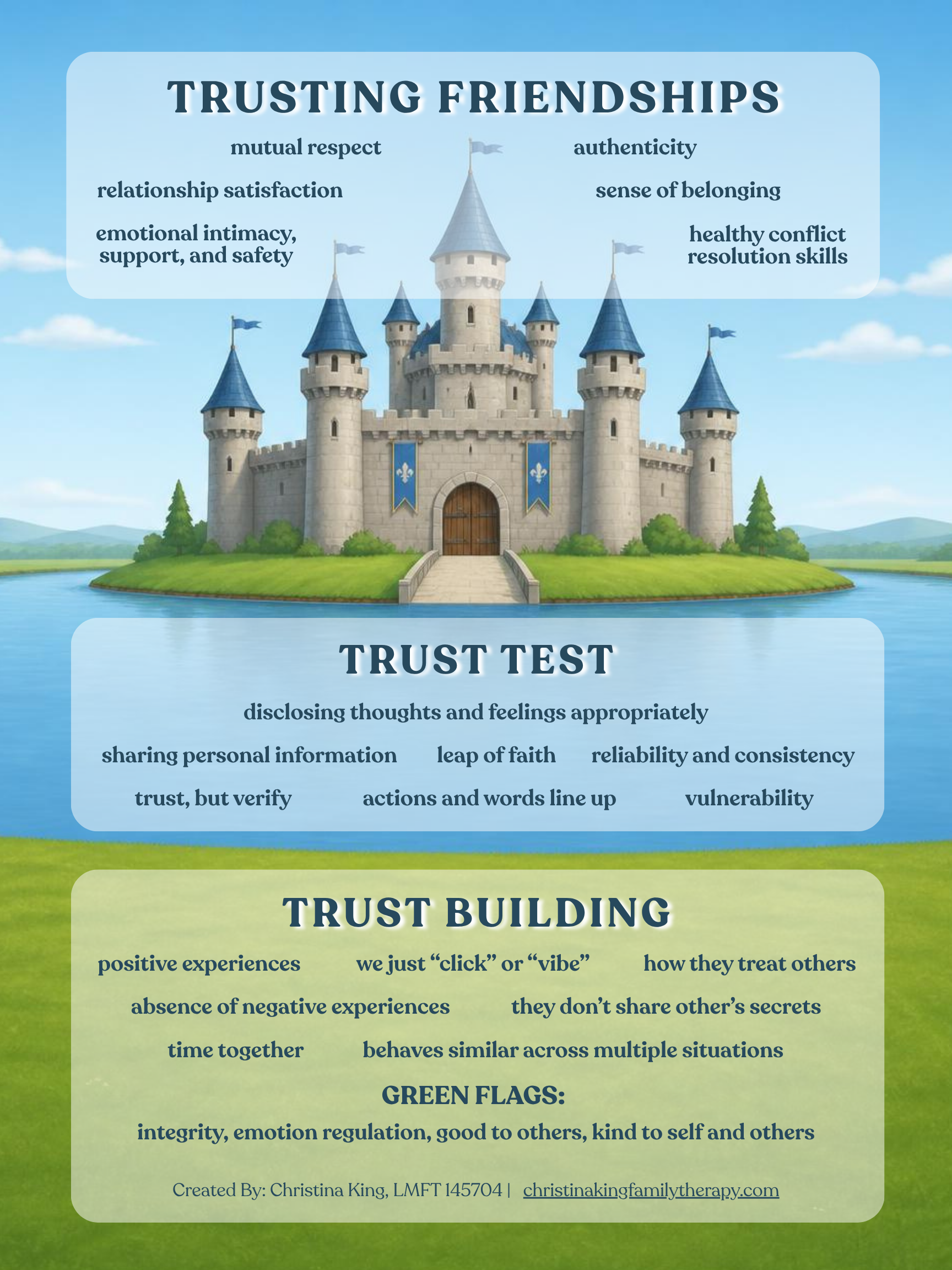
Here’s how I talk to teens about creating trusting relationships. I ask them to imagine a castle. In front of the castle is a moat and a large green lawn. These represent the three phases of friendship building.
Phase 1 – The “Trust Building” Stage / The Grass Lawn
Building trust inherently takes time. It is not a process we can rush. Often, trust begins through the accumulation of positive experiences. Using the metaphor of marbles in a jar is a great place to start. For every positive experience, a friend earns a marble in the jar. The more marbles someone accumulates, the more trustworthy they become.
Fikrlová et al. (2025) found that trust is shaped not only by positive experiences together, but also by the absence of negative experiences. Negative experiences remove marbles from the jar. Betrayal experiences can shatter the jar altogether.
Teens also tend to have a lower threshold for mistakes in friendships. Adults are generally more tolerant of relational friction, often taking frequency and intention into account (Fikrlová et al., 2025). For example, a teen may feel devastated if a friend forgets to wish them a happy birthday, whereas an adult may assume their friend was simply busy or forgot.
Understanding this helps explain why teen friendships can sometimes feel like a battleground. Friendships are both deeply valued and highly emotionally sensitive during adolescence.
Phase 2 – The “Trust Test” Stage / The Moat
At some point, there is usually a “trust test” in a friendship. This is the first time someone takes a leap of faith and shares something a little more personal. It requires the bravery to be vulnerable—to be seen, heard, and accepted for who you are. While this is a core human desire, it also carries the risk of rejection.
This does not need to be (nor should it be) your deepest, darkest secret. Instead, it’s about noticing how someone handles more sensitive information. The more sensitive the information, the bigger the marble.
We also need to acknowledge that trust always involves risk. Ultimately, we cannot know with certainty whether someone is trustworthy unless we take that chance. We don’t fully trust someone first and then begin sharing vulnerable parts of ourselves. More often, trust develops by taking small leaps of faith, sharing something meaningful, and observing how the other person responds. As the saying goes: trust, but verify.
Phase 3 – The “Trusting Friendship” Stage / The Castle
You finally make it into the castle. A trusting friendship involves mutual respect, reciprocity, and a deep sense of belonging. At this stage, both people understand one another on a deeper level and can turn to each other when life gets difficult.
All friendships experience ups and downs, but by this point, there is enough trust to repair conflict and navigate challenges constructively.
Yours In Service,
Christina King, LMFT 145704
Resources:
Allen, J.P., Narr, R.K., Kansky, J., & Szwedo, D.E. (2020). Adolescent peer relationships qualities as predictors or long-term romantic satisfaction. Child Development, 91(1), 327-340.
Fikrlová, J., Albrecht, A., Šerek, J., & Macek, P. (2025). “That’s how the trust began”: Forming trusting friendships from adolescence to adulthood. Journal of Social and Personal Relationships, 42(1), 52-72.
Güroğlu, B. (2022). The power of friendship: The developmental significance of friendships from a neuroscience perspective. Child Development Perspectives, 16(2), 110-117.